Brilliant founders.
Frustrated with tech.
The founders were exceptional businesspeople—they understood the opportunity in helping companies claim COVID-era Employee Retention Credits (ERC). The application process was notoriously complex, requiring extensive documentation, substantiation, and legal review. They saw a platform that could streamline the entire journey.
The problem? They had a development team, but felt stuck. Progress was slow. What was being built didn't match what they envisioned. The classic disconnect: leadership that understands tech as leverage, but struggles to communicate with the people building it.
They didn't need more developers. They needed someone who could bridge the gap.
Three phases of navigation.
See the Full Picture
We started with intensive whiteboarding sessions. Not writing code—drawing flows. Mapping the customer journey. Tracing data through the system. Understanding who touches what, when, and why.
The founders thought they were solving a simple problem. As we mapped it together, they saw the complexity underneath: customer uploads, documentation workflows, substantiation checkpoints, legal review gates, multi-role permissions, audit trails.
For the first time, they felt someone actually understood what they were trying to build. And for the first time, they themselves could see it clearly.
Build the Right Team
With clarity on where we were going, we assessed the existing team. The gap wasn't effort—it was autonomy. We needed engineers who could take a clear direction and run with it, without constant hand-holding.
I wrote job descriptions, posted roles, interviewed candidates, and assembled a smaller team built for self-management. Smaller than before—but faster. The right people with clear direction outperform a larger team without it. They stayed with the company well beyond my engagement.
Keep the Horizon Clear
The founders were busy doing what they did best—finding business, closing deals. My ongoing role was ensuring the development team always knew what was coming next.
As needs expanded, I documented them, reasoned through priorities, and communicated clearly to the team. No blockers. No confusion. Just a clear path forward while leadership focused on growth.
End-to-end ERC processing.
The platform streamlined the entire ERC application journey:
- Customer Portal — Guided journey for uploading documentation and tracking application status
- Internal Workflow — Role-based system for documentation specialists, substantiation experts, and tax attorneys to collaborate
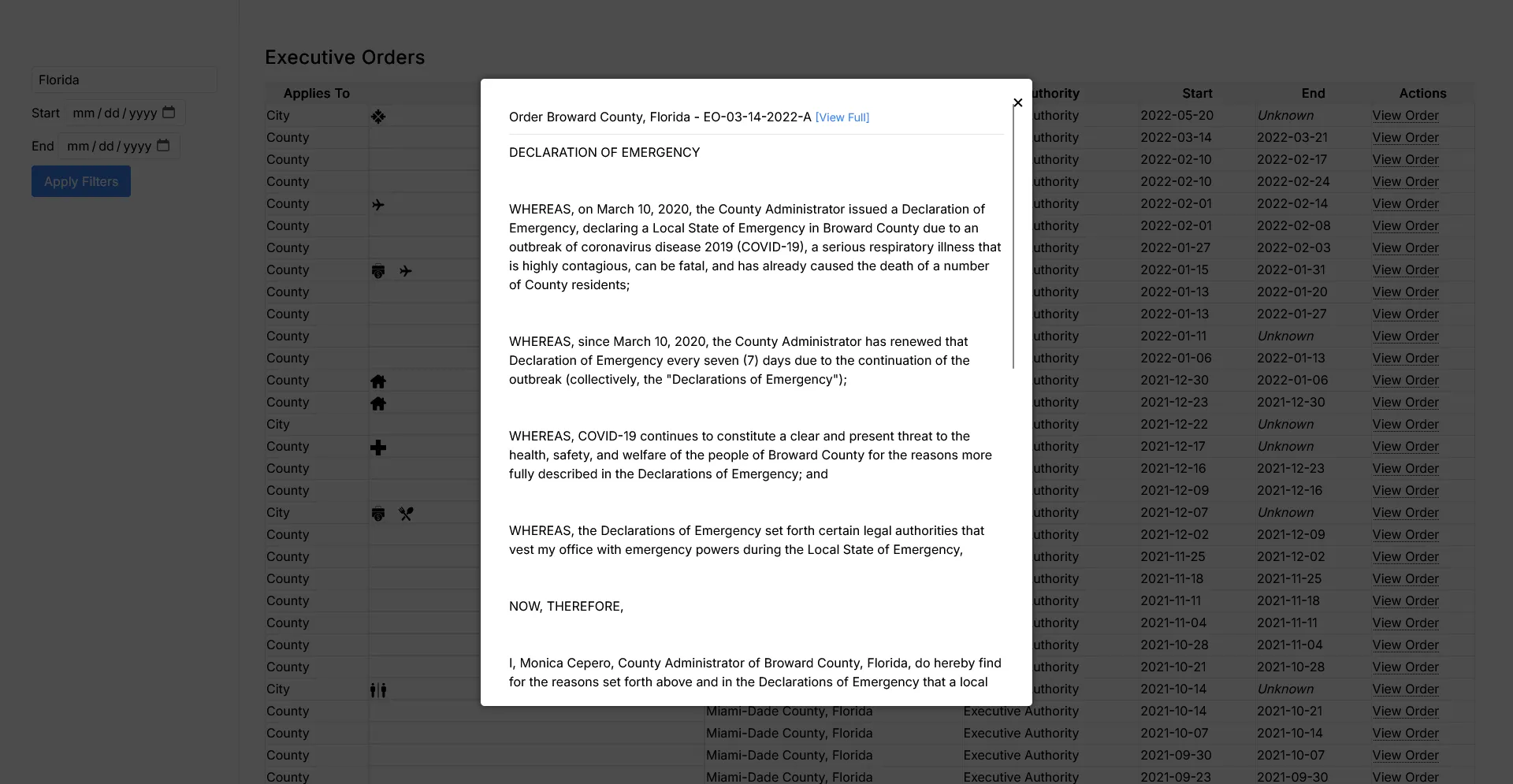
- Executive Order Database — AI-powered classification of 13,000+ federal and state executive orders, searchable by jurisdiction and department
- Audit Trail — Complete documentation chain for IRS compliance and future audits
AI before the hype.
This was 2022-2023—before ChatGPT made AI mainstream. We built classification pipelines using early GPT models and custom LLM approaches to segment and categorize executive orders across jurisdictions.
The result: one of the largest searchable databases of COVID-era executive orders, enabling attorneys to build ironclad substantiation cases backed by specific government directives that impacted each client's business.
Millions Processed
The platform processed millions of dollars in ERC credit claims, helping businesses recover funds they were entitled to.
Team That Lasted
The engineering team we built remained with the company well beyond my engagement—the right people in the right roles.
Audit-Ready
Every claim backed by searchable documentation and executive order citations. Built to withstand IRS scrutiny.
They didn't need more developers.
The founders came in frustrated with their tech team. What they actually needed was someone to help them see their own vision clearly—and then translate that vision into something a team could execute.
The new team was actually smaller than the original. But with clarity on where they were going and the autonomy to get there, they moved faster. More people isn't the answer. The right people with the right direction is.